eifl logo
Final report and impact assessment
I. Final Report – Summary Information
Report Due Date: 20th May 2011
Project Title: Establishment of the DAISY Talking Books Center
Organization Name: Ulaanbaatar Public Library
Primary Contact:
Last name Altantsetseg First name Choi
Title
Deputy director
Telephone 976-70115705
Address
Seoul Street – 7,
Ulaanbaatar 28,
Ulaanbaatar, Mongolia
Fax 976-70115703
E-mail ch_alt57@yahoo.com, altantsetseg@pl.ub.gov.mn
Web site
http://pl.ub.gov.mn
Grant Amount (U.S. dollars): USD 30000
Geographic Location(s) of project: Ulaanbaatar, capital city, and
21 province centers of Mongolia
Report Prepared by: Altantsetseg Ch. Date Submitted: 23/05/2011
II. Final Report – Narrative
SUMMARY
I. Background & Rationale: Clearly and (if possible) quantitatively articulate the problem you addressed, including the magnitude, history, and causes of the problem.
One of the most difficult problems to solve in the present-day Mongolia is the issue of supporting the vulnerable groups of people including those who cannot afford themselves in competing with the rest of the society. A special attention should be paid to the persons with visual impairment as they are more dependent on others.
Currently there are nearly 130 thousand people in Mongolia living visual disabilities of which 9,400 are partially or totally blind. Out of more than 9 thousand people only 150 are employed in some way. The overwhelming majority of the blind have an extremely limited access to the information and have to rely on the human reading which can be done very rarely and not available to everyone.
II. Goal & Objectives & Activities: Describe to what extent your project has achieved the goals outlined in your proposal. Please state each objective, and answer the following questions:
a. Briefly describe the activities carried out to meet the objective as described in your proposal.
The goal of the project was to increase possibilities for the low vision and blind people in having access to the information, especially to those which could be used in improving their living standards. For this end, a proposal was made to establish a studio that can make audio records in the most up-to-date digital format named DAISY.
b. Briefly describe any proposed activities that were not completed according to the proposed milestones, the reasons they were not completed and the plans for carrying them out.
c. If activities completed differ from your proposal what caused these changes?
d. If there were additional accomplishments beyond those originally planned, please describe them and explain what activities that led to these accomplishments.
There was one very important additional accomplishment beyond those originally planned. This is a renovation of the analogue audio studio that used to function at the Mongolian National Federation of the Blind, into the DAISY one. Our project helped them to realize that the new technology is far more effective and fruitful in the educational process. Thus, the opportunities of book preparation doubled during the planned period.
III. Achievements: List your top 5 achievements (accomplishments) for this project.
1. A professional DAISY Studio was established.
2. For the first time in Mongolia, digital audio books were recorded in a DAISY format
3. Very important is the fact that the modern technology achievements, i.e. the Information Communication Technology were introduced to improve the living conditions of the low vision and blind people.
4. It was possible to note that there were almost no services to the blind people in the province centers. Now these people have realized that there is something which could be done apart of their dwelling areas. In other words, the blind people have become more active and they have got a message that they could be integrated into the society through the educational process provided in the form of digital books and textbooks.
5. Once the Daisy books are distributed to all the province centers and the rural settlement libraries become involved in the cause of supporting the disabled persons, it is possible to say that a National Network of exchanging information for the low vision and blind people have been established for the first time in the history of the country.
IV. Communication: Describe the methods you used to market and communicate the project to different audiences (for example, policy makers, partners, users, the general public, other libraries and librarians, etc.)
We use all standard ways to communicate, and started daisycenter@pl.ub.gov.mn email list for province librarians to exchange information and experience,
and Blog, Twitter and Facebook page to make a support group.
- http://daisy-upl-mongolia.blogspot.com/
- https://www.facebook.com/pages/Daisy-Talking-Book-Center-News/102906149767043
- http://twitter.com/ubpubliclibrary
IMPACT ASSESSMENT
V. Impact Assessment: Describe what impact you believe the project had. Please provide appropriate evidence for all statements, based on your Impact Assessment Research.
a. Number of public library service points (libraries, branches or access points) providing the new service supported by the PLIP grant.
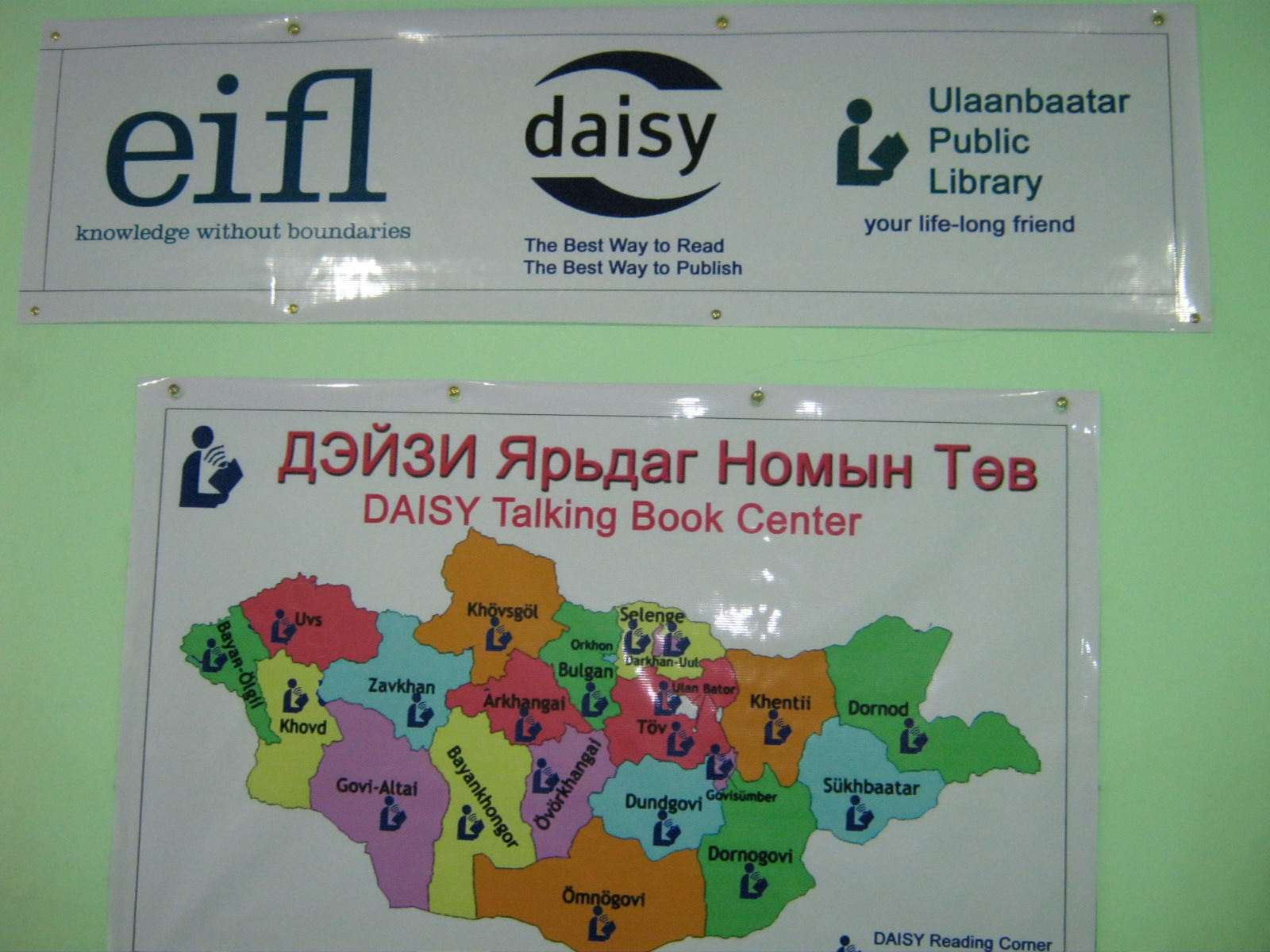
There are 26 DAISY talking book services provided through 26 points currently, which are as follows:
- The Reading Room, DAISY Talking Book Center, Ulaanbaatar Public Library
- The Audio Studio, Mongolian National Federation of the Blind
- The Special School No 116
- The Rehabilitation and Training Center
- The Cultural Club of the Occupational and Training Enterprise for the Blind People
- All the 21 province libraries
b. Percentage change in number of physical visits to public libraries supported by PLIP (change in overall user numbers since the project was implemented) [see Guidance note]
b/h. One week visits to read the DAISY books:
- The Reading Room, DAISY Talking Book Center, Ulaanbaatar Public Library
(baseline – 0, mid project – 10, end project 30)
- The Audio Studio, Mongolian National Federation of the Blind
(baseline – 0, mid project – 4, end project 17)
- The Special School No 116
(baseline – 0, mid project – 25, end project 45)***
- The Rehabilitation and Training Center
(baseline – 0, mid project – 20 massage course students, end project - 20)***
- The Culture Centre of the Occupational and Training Enterprise for the Blind People
(baseline – 0, mid project – one person in each of 5 days a week, end project -10)
- 21 provinces (Previously the low vision and blind people had never visited libraries in the provinces. Thanks to the project, rural people started realizing that there is such an important place does exist where one can go and get services that are useful and enjoyable. Currently on average there are 2 to 3 visits daily)
*** the number of visits increases during the operation of the Mobile Library (more listening devices leased for a certain period) in these places because they have 1 BookSense each
c. Total number of workstations and other pieces of equipment used by the new service (including equipment not paid for by PLIP) [see Guidance note]
d. Number of workstations and other pieces of equipment used by the new service paid for by PLIP (excluding equipment not paid for by PLIP) [see Guidance note]
2 workstations were bought as it had been stated in the project proposal. One is used only for the preparation of DAISY books. There was My Studio PC software installed in this computer. This program is for working to make quality records by the sighted readers.
The 2nd PC is used by the producer where the GOLDWAVE software had been installed. A sound card and a microphone are connected to the PC additionally. This PC is used for the DAISY production and editing.
The above computers are used for the duplication of DVDs that contain 24 titles of the recorded DAISY books.
One more computer was bought for the use in the DAISY Talking Book Center where people can browse the Internet for improving knowledge and for copying DAISY digital books directly to the BookSense DAISY player from that computer. 5 to 6 readers use this PC from 10 a.m. to 6 p.m. for 5 days a week (from Tuesday till Saturday included).
The 3rd additional computer was bought while using the balance appeared due to the discount of 40 pcs of BookSense provided from the seller.
e. Workstation use rate (for all workstations dedicated to the new service). [see Guidance note]
A – 3, B – 3 (100%)
f. Number of library workers or partners trained under the PLIP grant.
The following librarians attended the training classes:
- Librarian of the Reading Room, DAISY Taking Book Center
- A sighted reader of the DAISY Talking Book Center
- Volunteer 25 sighted readers to work on MyPC software for making records.
- Librarian of the Special School No 116
- Head of the Rehabilitation and Training Center
- Head of the Cultural Club, the Occupational and Training Enterprise for the Blind People
- Librarians of 21 provinces (2 persons) or 42 librarians
Totally 72 persons
g. Number of library users trained by the PLIP program in the skills described in the proposal.
Approximately 250 low vision and blind persons were trained to use the BookSense device and listen to the records. Many of them were re-trained (especially the those came from the provinces to study at the Rehabilitation Center) once again as more learning was needed to get a full understanding.
h. Increase in users from the target audience (specific target audience e.g. jobseekers, scholars, farmers) for the new service.
i. Impact on users and staff.
i. Results from questionnaires for users
Questionnaire 1 (among 50 users – including those asked by the telephone from provinces)
1. What is the significance of the DAISY equipment?
* This is very important for improving the knowledge and getting information
* This is especially important for the people who do not know Braille scrip
* Also it is easy to use because the Braille books are heavy to carry. BookSenses are very quick
in turning pages.
2. What should be done to improve the DAISY services?
* More should be done increase the points of services to reach more people.
* Increase the number of devices per point because currently there are only one at each place.
* Find devices with a lower price, if possible.
3. What was the most specific interesting thing of these services?
* Page-by-page, section-by-section, heading-by-heading, sentence-by-sentence is the most amazing specifics of this technology. It was an expected and unbelievable to everyone.
* Advantages of this services are that while reading the DAISY books one can also listen to the FM radio.
4. What would you suggest to the project implementation team?
* More voices were recommended to make the records more interesting, especially the books with many pages.
* Many people asked to forward a message of gratitude to the EIFL-PLIP Program
ii. Results from questionnaire for staff
Annex 2. Questionnaire 2 (among 25 librarians of the city and from 21 provinces)
1. How the local authorities, rural librarians and the visually impaired people in the province did accept this project?
• It was greatly appreciated by everybody
• It is an incomparable opportunity for these people to increase information availability.
2. Does this technology truly important for the low vision and blind people?
• Yes, this technology even serves as a bridge among visually impaired and the sighted people
3. What were the difficulties when using the DAISY technologies?
• Instructions in English make it uneasy to learn the operation of devices
4. Do the librarians need some kind of training when working with the low vision people?
• Yes, the training is needed. For instance, there should be a kind of “Mobility Training” which means that both the librarians and the visitors should be trained in learning where to go, for instance, explain – where is the Restroom, how does it operated, etc.
5. How did the number of visitors increase after the DAISY technology had been introduced?
• The number has visibly increased
6. What kind of organizational issues should be solved in rural areas?
• A special room is needed for the visitors
• Accessibility devices like the bars at the wall to touch, Braille road and notes in the corridors are much needed for the blind visitors.
iii. Results from focus groups [at least one if appropriate]
j. Did you find the impact evaluation useful?
Yes, it really helps us to realize more clearly what have done and at what extent
k. Will you carry on assessing impact after the project ends and if so, how?
After the end of the project we will conduct fund raising activities and if successful, will outline our future actions due to the funds available. We will continue the assessing the impact as it was understood as the most important way of monitoring the cause of the process.
l. Annexes (please attach to the Final Report)
E.g. Questionnaires, focus group scripts etc.
PARTNERSHIPS
Please list the partner organizations you worked with to implement the PLIP project and describe the role and contribution of each one.
There is one partner organization but it is very active and much concerned in the successful implementation of the project. This is the Mongolian National Federation of the Blind. Established in 1978, it has branches all the provinces and conducts many-sided activities for improving the educational level of its members, providing job opportunities, protecting their rights and supporting the involvement of the blind in the normal social life.
The MNFB's role in the elaboration, publicity and successful implementation of the project was enormous. All its branches and institutions like the Rehabilitation and Training Center for the Blind, the Braille and Talking Books Publishing Center, the “Best Massage” Chain, the “Best FM98.5” and the Specialized School No 116 were actively involved in the process of introducing the DAISY technology and making it adapted well in the Mongolian conditions.
LESSONS AND LEARNING
Here we wish to understand some of the lessons you and your library learnt through implementing the PLIP project. The following categories are a guide – please feel free to write about any other learning you think was important.
Implementation
What worked well and what did not?
Every component of the project was done well.
Challenges
Discuss how you have addressed the anticipated challenges. Have there been any additional internal or external challenges? How were they addressed?
a. There were some financial constraints caused by the sudden rise of prices for the materials needed to buy for establishing the studio.
b. One of the most difficult issues encountered was the finding of a good sighted reader. It took some time but was solved. However, when the sited reader was to be looked for to work on a voluntary basis, only students approached us. Though the students are welcomed to work, they have limited time to spend in the studio. We were more interested in the retired professionals like former actors, etc. but nobody had come. Probably, there is something wrong with the involvement of the retired people in the socially needed works as the majority of them may have understood that it's shameful for the elders to be mixed with the youngsters. There seems absent a kind of mechanism that would encourage and motivate the pensioners to be socially active and be able to contribute their knowledge and talents to the well-being of others, especially to those who are in a strong need.
c. We did not expect that the work with the disabled people would be so much difficult and demand extra efforts when realizing the tasks set forth. For instance, low vision people have to be accompanied to come, they need special care and understanding. Fortunately, the partner organization was much active and carried much of the load on its shoulders.
d. One BookSense was lost as a result of theft. When lost, the user would have to compensate the loss which is a heavy burden to handicapped people because the cost exceeds their allowance several times.
Learning about partnerships
The cooperation with the MNFB eased greatly the implementation of the project due to the following facts:
What was the most successful partnership, and why?
* The Federation has branches in all the province centers and their activists help the rural librarians intensively.
Please describe any challenges you encountered in working with partner organizations.
* They themselves have upgraded their audio studio into the DAISY one. According to the project plan, 12 books were to be recorded. This work has been completed successfully. In other words, during the planned period 12 digital books were prepared for the first time in Mongolia. But if to add another 5 that were transferred from analogue audio into DAISY format at the MNFB's studio, the total number would be increased almost by 50%. Furthermore, the renovated MNFB’s studio which has become a DAISY studio also, prepared 12 more titles. So, the total number of DAISY books, thanks to the partnership, reached 29 and has increased by 150% as compared to the planned number.
Discuss why these challenges came about and what steps you took to overcome them.
* The Federation uses the BookSense equipment intensively even at their meetings and workshops – they make records by BookSense and distribute copies in DAISY format. Thus the equipment's utilization is expending which is important for the popularization of the DAISY books.
Technology
How appropriate was the technology you chose for your PLIP? How effective was the technology in supporting your service. What challenges were there in procuring, installing, housing and using the technology? How well did library staff and users manage to use the technology?
This is truly amazing device and everybody is of high impression. The only problem was caused due to the wrong handling by the users who made 6 of them broken. 2 were repaired 4 are still at the factory.
Booksense device’s price is pretty high for the Mongolian conditions and province public libraries cannot afford themselves to increase the number. The instructions are in English only which makes them not easy to use by the visitors.
Replicability of the project
What recommendations do you have for other organizations attempting similar projects? These should be both project specific as well as broader lessons (i.e. best practices, cultural messages/attitudes, reflections on partnerships etc.). How will these lessons be communicated to the stakeholders?
The following are the recommendations that seems to be important if the similar project being planned and implemented in other countries:
* The most important is the choosing of a partner organization that is preferably to be an NGO dedicated to help the disabled people as the library alone can not carry on all the duties.
* Very important is the support on the side of Government and the local authorities which should be aware of the project from the very beginning.
* The equipment's instructions should be well translated and distributed in different forms. We firstly printed it and copied as a manual. Then recorded as a DAISY manual or made it audio. And thirdly, it was transformed into a video manual and distributed as DVDs thus making possible to train the librarians and anyone interested in learning about its correct usage. It is understood that thanks to these efforts, plus intensive trainings, not many devices were broken.
* Alongside with the project implementation, there should be organized some kind of public activities aimed at making the people and institutions realize the importance of these equipment to the low vision person. These may help in fund raising to increase the number devices at one point.
* The involvement of professional sited readers could become a real challenge. This issue might be solved if some NGOs become voluntarily responsible for the contact with the interested people.
SUSTAINABILITY
Future work
Will you continue the service at the end of the EIFL PLIP project cycle? What will the continued service be, and through what partnerships and resources will you sustain it? Have the outputs of this grant fed into your planning for future activities?
The MNFB has 2 good sighted readers and one is working at our DAISY Studio now. Thanks to this, we are planning to record new books and 3 titles are ready for the reading.
Other Sources of Project Support:
Did your project receive the support you anticipated and told us about in the proposal? (If applicable) Have there been any additional sources of support for this project, including in-kind gifts, equipment etc? Detail organization, amount/type, date received.
* The Ulaanbaatar Public Library will continue supporting the project by providing the facilities free-of-charge and DAISY Studio manager will be provided with a salary starting from September.
* The US Embassy provided a study tour grant to Mr. Begzsuren, Project's IT Manager for internship learning the work of the Maryland State Library for the Blind and Physically Handicapped in October, 2010.
* Mr. Tsengel, Project DAISY Expert, was granted to participate in the Mongolian Text-to-Speech Development Project by the World Bank in Thailand (Feb-April, 2011)
FEEDBACK
Here please comment on EIFL-PLIP support. Was/is there anything more the PLIP program managers could have done to assist you? (Lessons for EIFL)
We are thankful to the EIFL-PLIP program managers who were so kind in answering all the questions we didn't know, advising promptly on what we hesitated and directing us in the ways the project should go as scheduled. We believe that the managers did the work excellently and we are happy for cooperating in the project implementation.
Thursday, June 23, 2011

Wednesday, March 9, 2011
Interviews on DAISY Talking book usage
BLIND MASSAGEURS OF MONGOLIA STARTED READING DAISY BOOKS
Enhamgalan, age 43, totally blind
“Representing other I have come alone from Hentii aimag. I have been attending a 6-months massagers’ course at the Rehabilitation and Training Center for the Blind, National Federation of the Blind.
I have become blind when grown up and that’s why doing know how to read and write in Braille. However, I am so happy to listen to the audio books brought from the DAISY Talking Books Center of the Ulaanbaatar Public Library. We were thought how to use a Book Sense device and in the dormitory after the classes, we listen to the Massage Manual and Human Body’s Anatomy every day. It helps me greatly in my studies.
I truly like this equipment as I feel as reading a real book turning the pages, jumping quickly to the subjects and different parts of the book. It is so easy and makes a fun.
When finishing the courses I will leave the BookSense here and return to my province where I will immediately visit the library asking about the possibility of using this kind of services. I also hope to have my own one as I feel it to be like my best friend.”
Erdenebat, 38, totally blind.
Citizen of Ulaanbaatar city, a driver, lost the vision due to the road accidence.
“Before attending the massage courses I didn’t know that such excellent equipment had ever existed. Thanks to this project I have got a confidence that I would successfully complete the courses. I am changing my profession and I was not sure that can become a true massager. I didn’t know the Braille script and wasn’t able to read the manuals written on it. Now I believe in myself because the listening of DAISY books helped me to understand a lot, get deeper knowledge and have clear vision of what is massaging.”
DAISY BOOKS ENLIGHTEN THE FUTURE OF THE STUDENTS OF THE SPECIAL SCHOOL No 116
Angarag-Erdene, age 15, 9th grade student
Citizen of Ulaanbaatar city has been studying in this school since 2003, lives in the school dormitory.
“Our class has 5 students. I have learned everything how to use the BookSense. I have found brilliant technological advantages of this device. While reading with the BookSense, it is possible to make Bookmarks, the recording is so pure, the memory is huge, makes recording directly from FM radios, goes immediately to the pages, gives a feeling of travelling through the content. BookSense can tell me total time, elapsed time, remaining time, total pages, current pages and other unbelievable opportunities. I wish our school library have some more BookSenses. My dream is to successfully graduate the secondary school and become a good software engineer.”
Batzul, 9th grade student.
While coming to the school library I looked to the Universe through the Braille and audio books. Now there is a chance to see it via DAISY books which is even easier. I attended the BookSense training classes 3 times, that is why I can operate it very well. I have memorized all the buttons and now can touch them instantly. I wish to study for a musician and composer.
Davaanyam, teacher of Mongolian language and literature. Has been working as teacher to the children with visual and hearing disparities since 1985.
“It is found to be a much more advanced technology compared to the audio that had been used by us. Since November 2010 the BookSense device has been introduced to 80 students of the school. They are so happy to use the new device because it saves time and greatly increases the motivation. The children simply love the BookSenses. The Braille has some advantages as it improves memory and helps to learn concentration. However, thick books like a novel are better to be listened in a DAISY format. It is also uncomparable in bringing the emotions of the content.”
Sanduidemchig, school librarian
“After finishing this school I continued studying in the college for the librarian. I have been working here since 2005. The school library has 18 seats and provides services both to the teachers and students. It has 2,000 books in Cyrillic, approximately 2,000 Braille books and nearly 200 audio books.
Since October 2010 our stock has enriched with 12 DAISY books. I am much happy for the new and progressive technologies being introduced in our library.
Over 50 students were involved in the BookSense training classes. There is a high demand in using it and students are asking to increase the number of DAISY book readers. There are books that should be read by every student of the school. Two DAISY books were included in this list. The Moving Library with 10 more devices, helped us much to learn this new technology”
In the Rehabilitation and Training Center for the Blind
Munhzul, Director
Here are mostly coming people from the provinces and those who have lost the vision at grown up ages. These kinds of people suffer a lot and need a special type of care and re-training. It was a big puzzle how to approach these people as it is not easy to find an appropriate way of teaching. There was time when we read the books ourselves. Then the teachers started using cassettes, CDs and record the manuals. The DAISY book technology has facilitated the work by 100 percent. Also possibility of listening manuals recorded by professional readers and provided via the real-book imitated device with great selection opportunities, highly improves the quality of our training.
If previously the manuals were in shortage, and the trainees had less opportunity to make notes by them, use those notes, now the situation has completely changed and even it is possible for the teachers to make demands to do the homework, if necessary.
The Moving Library from DAISY Talking Books Center of the Ulaanbaatar Public Library improves efficiency to the training process because 10 devices were brought for us here. In future, we would like to have sufficient number of DAISY books readers in our Center.
For more information about PLIP: http://www.eifl.net/plip/
DAISY Talking Book Center Facebook Page: https://www.facebook.com/pages/Daisy-Talking-Book-Center-News/102906149767043#!/pages/Daisy-Talking-Book-Center-News/102906149767043?v=wall
DAISY Talking Book Center Facebook Page: https://www.facebook.com/pages/Daisy-Talking-Book-Center-News/102906149767043#!/pages/Daisy-Talking-Book-Center-News/102906149767043?v=wall
Tuesday, January 11, 2011
DVD Cover is ready
Our project is continuing well.
DVD Cover is printed by us, and we are preparing 150 DVD with Mongolian DAISY titles.

DAISY ярьдаг номын зохиогчийн эрх
DAISY номыг ашиглах нөхцөл
DVD Cover is printed by us, and we are preparing 150 DVD with Mongolian DAISY titles.

Улаанбаатар хотын нийтийн төв номын сангийн
DAISY Ярьдаг номын төв
DAISY Ярьдаг номын төв
Daisy ярьдаг номЫН DVD. Volume 1
“Эх зохиолын дээжис” 1 боть. Ш.Соёлзул
249 хуудас, 185 гарчиг, 9 цаг 39 мин 38 сек
249 хуудас, 185 гарчиг, 9 цаг 39 мин 38 сек
“Эх зохиолын дээжис” 2 боть. Ш.Соёлзул
394 хуудас, 223 гарчиг, 19 цаг 43 мин 5 сек
394 хуудас, 223 гарчиг, 19 цаг 43 мин 5 сек
“Өөртөө туслах ухаан”. Смайлс Самуэл
140 хуудас, 134 гарчиг, 6 цаг 38 мин 10 сек
140 хуудас, 134 гарчиг, 6 цаг 38 мин 10 сек
“Жангар”. Ц.Дамдинсүрэн
260 хуудас, 28 гарчиг, 6 цаг 19 мин 30 сек
260 хуудас, 28 гарчиг, 6 цаг 19 мин 30 сек
“Шинэ технологи үйлдвэрлэлд”. С.Нарангэрэл 125 хуудас, 257 гарчиг, 5 цаг 3 мин 34 сек
“Санхүүгийн хөтөч”. Нээлттэй Нийгэм Форум
158 хуудас, 117 гарчиг, 5 цаг 52 мин 34 сек
158 хуудас, 117 гарчиг, 5 цаг 52 мин 34 сек
“Мастер Маргарита хоёр”. М.А.Булгаков
410 хуудас, 72 гарчиг, 16 цаг 52 мин 51 сек
410 хуудас, 72 гарчиг, 16 цаг 52 мин 51 сек
“Япон массажын гарын авлага”. Т.Мөнхтуул
86 хуудас, 119 гарчиг, 3 цаг 52 мин 18 сек
86 хуудас, 119 гарчиг, 3 цаг 52 мин 18 сек
“Дэлхий дахины түүх” 1 боть.
263 хуудас, 119 гарчиг, 9 цаг 57 мин 0 сек
263 хуудас, 119 гарчиг, 9 цаг 57 мин 0 сек
“Дэлхий дахины түүх” 2 боть.
504 хуудас, 128 гарчиг, 21 цаг 59 мин 45 сек
504 хуудас, 128 гарчиг, 21 цаг 59 мин 45 сек
“Хүний биеийн бүтэц зүйн лекц”.
219 хуудас, 56 гарчиг, 13 цаг 57 мин 22 сек
219 хуудас, 56 гарчиг, 13 цаг 57 мин 22 сек
“Монгол улсын түүх”.
453 хуудас, 56 гарчиг, 18 цаг 23 мин 5 сек
453 хуудас, 56 гарчиг, 18 цаг 23 мин 5 сек
2011 оны 1-р сарын 11 Дотор талыг уншина уу
Д. Нацагдоржын нэрэмжит Улаанбаатар хотын нийтийн төв номын сангийн DAISY Тоон Ярьдаг Номын Төв
DAISY ярьдаг номын зохиогчийн эрх
Энэхүү бүтээлийг Монгол Улсын Зохиогчийн эрхийн тухай хуулийн Зохиогчийн эрхийн бүтээлийг ашиглах тухай Зургадугаар бүлгийн Зохиогчийн эрхийн зөрчилд тооцохгүй байх онцгой нөхцөлүүдийг заасан 24-р зүйлийн 24.2.1-р заалтад зааснаар ашиг олох зорилгогүйгээр, мөн хуулийн 24.1.7-р заалтыг үндэслэн хараа болон сонсголын согогтой хүмүүсийн хэрэгцээнд зориулж, Зохиогчийн эрхийн тухай хуульд нийцүүлэн бүтээв.
Мөн Олон улсын номын сангийн холбооны Оюуны өмчийн эрхийн тухай байр суурийг баримталж, Хараагүй, хэлгүй, болон суралцах хөгжлийн бэрхшээлтэй иргэдийг ялгаварлан гадуурхахын эсрэг, тэдэнд зориулан оюуны өмчийн эрхээр хамгаалагдсан бүтээлийн форматыг өөрчлөх зэргээр хүртээлтэй болгох нь зохиогчийн эрхийг зөрчих зөрчилд тооцох ёсгүй гэснийг мөрдлөг болгов.
DAISY номыг ашиглах нөхцөл
1. DAISY ярьдаг номын төв болон орон нутгийн салбаруудын уншигч үйлчлүүлэгчдэд DAISY номыг DAISY ном тоглуулагч төхөөрөмж дээр хувилан сонсох эрхийг олгов.
2. Хараагүй хүмүүст зориулагдсан DAISY ном тоглуулагч программ болон дэлгэц уншигч программын орчинд DAISY номыг компьютер дээр ашиглах эрхийг олгов.
3. Бусад бүх эрх Д. Нацагдоржийн нэрэмжит Улаанбаатар хотын нийтийн төв номын сангийн DAISY студид хамаарагдана.
Хотын нийтийн төв номын сангийн дэд захирал, төслийн зохицуулагч Ч.Алтанцэцэг. Утас: 70115705, 98995293
Брайль ба Ярьдаг номын төвийн номын санч П.Оюунбаяр. Утас: 99167079, ДЭЙЗИ цахим номын мэргэжилтэн М.Цэнгэл 98884466
Thursday, January 6, 2011
December 2010 News
1/


Nov.22, 2010
20 trainees who had arrived to the Rehabilitation Training Center of the Blind for the 6-months Massage Training Courses from the provinces, were being taught how to use BookSense devices.
2/
Nov.22, 2010
10 persons were trained in morning and 10 persons - in evening hours. So, the morning courses on the use of DAISY books and BookSense devices were conducted between 11:30 to 12:30 and 4:30 to 5:30 respectively.
3/
Nov.22-24, 2010
DAISY and BookSense classes were conducted earlier by request of 10 persons who had been trained at Massage Courses – from 11:30 instead of 4:30 because the streets fall in darkness quickly in winter.
4/
Classes were conducted by this schedule from November 25 through December 7, 2010
Advantages
People were much active and though the devices descriptions were in English they did their best to learn quickly. They were especially grateful that the books were listened to as if reading the real books – from any page they wish to start.
Difficulties
These are very new devices and all the participants were to be introduced to the button schemes. Knowledge of numbers and teaching of some English was needed to help the readers to learn the instructions.
5/
from december,8,through december,17,2010 When teaching how to use DAISY books and BookSense devices, the computer and English training was also conducted to 10 persons from 2:00 to 3:00, at the Rehabilitation Training Center of the Blind.
Advantages
When learning English and computers the readers were more enthusiastic in learning the new devices.
6/
Dec 8 to Dec 17, 2010
Started were classes on the use of DAISY books and BookSense devices at the Special Sekondary School No 116 of visually impaired children.
7/ 30 Children of 8 and 9 grades were taken part in the classes. 8 children attended the classes at one time.
Advantages
Children were especially grateful as the history textbook and some fiction literature, included in the school program, had been recorded. The teachers were also glad to know that these books had appeared in a digital format as in last 20 years only printed forms were available.
Difficulties
The main problem is the lack of elementary English which should be further taken into account.
7/
Dec 11, 2010
From 12:00 to 4:00 DAISY Expert Tsengel and librarian Oyunbayar addended classes organized by the Mongolian National Federation of the Blind on the management of event designated for the people with visadual disabilities.
8/
Dec 13, 2010
In the framework of the project, the DAISY Talking Book Center in cooperation with the Mongolian National Federation of the Blind started a Volunters Program on reading the books in DAISY format. The announcement on selecting the volunter readers was made from Dec 13 to 18, 2010, on Internet and through the FM run by the MNFB.
9/
Dec 18, 2010
13 persons have come to take part in the selection contest to become a volunteer reader. The exams were conducted from 11:00 to 5:00. They were to read and make 7 minute recording from 2 kinds of books.
10/
Dec 21, 2010
At noon 10 persons were selected and they were instructed how to continue in reading DAISY books.
11/
Nov 29, 2010
- The 2nd volume of the Mongolian Classics and the historic epic “Jangar” were added to the 10 books and the total number of DAISY books has become 12.
- 12 books were copied to all 39 BookSense devices
- 1 BookSense is awaited for replacement (not yet received from the manufacturer)
12/
Nov 22, 2010
10 BookSense devices are used at the the Rehabilitation Training Center of the Blind to provide training to 20 Massage Training Course persons on the use of BookSense devices and for teaching English and computer programs to 10 persons
13/
Dec 3, 2010
In the morning, 4 Booksense devices and 12 books were handed over to the Project Team Coordinator Ch.Altantsetseg.
14/
Dec 3, 2010
7 BookSense devices are used in the educational process at the Special School 116 by organizing the Moving Library mechanism.
One BookSense device is used at the DAISY STUDIO.
15/
Dec 12, 2010
Preparation of the broken BookSense devices for delivery
16/
Dec 13, 2010
Delivering to the manufacturer in South Korea
Public Opinion Poll
1. What is importance of the DAISY service to your mind?
2. What could be done to improve the DAISY services?
3. What was the most impressive thing from the time when the project has started?
4. What was the sudden and unexpected thing during the implementation period?
5. What are your colleagues saying about?
6. Are they satisfied with DAISY services?
To compile all the answers received, it is possible to note that the DAISY services were received with great enthusiasm, they brought a light to the minds and hope for the vivid improvement of the educational status to the visually impaired and blind persons.
People were glad to know that there exists a technology which makes it possible to listen to the book as if it is read – stopped and started from and at any place or page. The availability of the classics, history and other textbooks, massage manuals and advices on different subjects were welcomed by the readers as an important start up.
As regards the devices, many were impressed with the DAISY equipment because it is much different from just audio devices. They noted that thanks to the project the librarians got acquainted with the modern technology and they would try applying for the procurement to the province and other libraries.
Among the wishes on what to be done for the improvement of services, the suggestion was made to increase the number of voices that are listened at different books. More interesting would be if each book to be read by several readers simultaneously.
- http://www.youtube.com/watch?v=EUl597JbDjY
- http://www.youtube.com/watch?v=X1z5bzUuIZI
- http://www.youtube.com/watch?v=PmpjAqbPPhY
- http://www.youtube.com/watch?v=ucxYj-h2R2o
- http://www.youtube.com/watch?v=B6drcfLZnHc
- http://www.youtube.com/watch?v=oA5Cf86Hphg
- http://www.youtube.com/watch?v=DtHrHpHB8Eg
- http://www.youtube.com/watch?v=g4VK6cjhtXA
- http://www.youtube.com/watch?v=psk68KLPxI0
- http://www.youtube.com/watch?v=hpC8luS9a3E
- http://www.youtube.com/watch?v=glTSYelkMvg
- http://www.youtube.com/watch?v=v3PlLY2Gnmo
- http://www.youtube.com/watch?v=JCyWMV5qVK4
- http://www.youtube.com/watch?v=5BhA594o3E4




Tuesday, January 4, 2011
Postcard from PLIP Team 2nd Meeting, Kenya
Dear PLIP Friends,
HAPPY NEW YEAR!
I wish you good health to you and success to your work!
I'm happy to receive and read your warm greeting postcard from Nairobi, Kenya!
I opened your post in 3rd of December and uploaded postcard images:
http://daisy-upl-mongolia.blogspot.com/2011/01/postcard-from-plip-team-2nd-meeting.html
Why so late, because I had a medical operation on hemorrhoids thrombosis in 22nd
of December, then I just back to my work in 3rd of December.
Sincerely Yours,
J.Begzsuren
HAPPY NEW YEAR!
I wish you good health to you and success to your work!
I'm happy to receive and read your warm greeting postcard from Nairobi, Kenya!
I opened your post in 3rd of December and uploaded postcard images:
http://daisy-upl-mongolia.blogspot.com/2011/01/postcard-from-plip-team-2nd-meeting.html
Why so late, because I had a medical operation on hemorrhoids thrombosis in 22nd
of December, then I just back to my work in 3rd of December.
Sincerely Yours,
J.Begzsuren
Date: Wed, January 5, 2011 11:43:41 PM
Dear Begzsuren,
Nice to receive a word from you. I missed it around Christmas and New year! Now I have an explanation. I hope you feel well after the medical treatment.
I wish you and your family all best in the new year.
Very sweet to publish a postcard from Nairobi. I wish PLIP family to be like the lion family on the postcard: strong and connected.
Big hug!


Monday, November 1, 2010
Mr. Begzsuren successfully started to use Skype, so he is a Skype first user from Ulaanbaatar Public Library staffs
I really want to inform this happy news to our DAISY news blog.
Today I installed Skype software and got a account "jbegzsuren" for our future easy calling and communication.
Then I made successful calling with Mrs. Jean from UK, Mr. Tsengel from DAISY Studio at UPL.
Last May, I heard about Skype in the meeting of Public Library Innovation Program, Ljubljana, Slovenia and I had a chance to buy a headphone and microphone at Inch-eon International Airport in October 19th by Korean Air 10th anniversary 10$ gift certificate add my 13$.
If you want to call to me my Skype id is jbegzsuren. I'm a project member on DAISY Talking Books Center of Mongolia in Ulaanbaatar Public Library.
Today I installed Skype software and got a account "jbegzsuren" for our future easy calling and communication.
Then I made successful calling with Mrs. Jean from UK, Mr. Tsengel from DAISY Studio at UPL.
Last May, I heard about Skype in the meeting of Public Library Innovation Program, Ljubljana, Slovenia and I had a chance to buy a headphone and microphone at Inch-eon International Airport in October 19th by Korean Air 10th anniversary 10$ gift certificate add my 13$.
If you want to call to me my Skype id is jbegzsuren. I'm a project member on DAISY Talking Books Center of Mongolia in Ulaanbaatar Public Library.
Friday, October 22, 2010
DAISY center's IT expert successfully finished his library internship program in Maryland State Library for the Blind and Physically Handicapped
Ulaanbaatar Public Library is host organization of the DAISY Talking Book Center in Mongolia. This library's IT Manager and DAISY Project's IT Advisor Mr. Begzsuren visited to the Baltimore city, MD, USA in 1-18th of October, 2010.
It was 2 weeks internship in the Enoch Pratt Free Library and Maryland State Library for the Blind and Physically Handicapped.
For more information about his internship, http://lip-news.blogspot.com
It was 2 weeks internship in the Enoch Pratt Free Library and Maryland State Library for the Blind and Physically Handicapped.
For more information about his internship, http://lip-news.blogspot.com
Subscribe to:
Posts (Atom)